|
This guide shows how most 240 volt hot tubs and portable home spas are
wired, with photos, a step-by-step
hook-up movie
& hot tub schematic wiring diagrams. This information is provided to
help you to be a more informed consumer. We advise hiring a licensed
electrician to wire and install a spa. If you're not confident and
qualified to do electric wiring, there's still installation prep work you can do
to reduce expenses. We'll
walk you through a typical project to show what's involved.
About
120V
hot tubs.
CAUTION:
Electrical work and repairs can be dangerous, especially
around water. There is a risk of shock or electrocution, which
could result in serious injury or death. We strongly advise that
hot tub electrical wiring be referred to a licensed electrician. Local
code requirements for wiring vary and may differ from the
educational examples on this web site. The local code regulations
must be followed, with permits and inspections obtained. The
installer should read and follow the hot tub owner's manual and
associated electrical component owner's manuals and
instructions. Regardless of who performs the work, be sure that
power to the spa circuit is switched off at the house service
panel prior to inspections, wiring, or repairs. Improper wiring
may damage equipment and void the spa manufacturer's warranty.
Disclaimer
|
|
|
Your Electrical Service
Before installing a major appliance like a hot tub, determine if the electric
service will handle the extra load. It's usually not a problem, since most homes
built in the last 30-40 years have at least a 100 amp
service, with 150-200A common in newer homes. Panel ratings are normally labeled near the main breaker at
the top. |

Service Panel |
|
It's a common misconception that the sum total of the amps of all
the circuit breakers installed must not exceed the service panel's indicated amp rating. This is
false-- capacity is determined by load calculations, not the
size or number of its breakers.
Spa Wiring Basics - 240V Systems
We'll begin with an overview of the electrical requirements for
wiring a hot tub, as
illustrated by our interactive
wiring diagrams
below. A 240V spa must be supplied by a circuit which meets its load
requirements (amperage) as indicated in owner's manual.
This means that the feeder breaker (in the house service panel)
must be of the specified size, and that the GFCI breaker in the
disconnect panel must be at least that size (larger is fine) and
is
GFCI
protected
for safety.
We're using a typical outdoor portable home spa installation for our
example. |
| The three electrical assemblies involved in this project are
the: |
- House Circuit Breaker Panel
- Outside Disconnect GFCI Box*
- Spa Control System Box
|
|
Connecticut Electric
Disconnect GFCI Panel
for Hot Tubs up to 60A
with bonus
120V Branch Circuit
for Receptacle |
 |
*The National Electrical Code (NEC)
specifies installation of an approved manual disconnect
device adjacent to the hot tub, at least 5 feet away, and within line
of sight. The NEC also requires a 120V
receptacle within a 10-20 foot distance from the spa. |
Installing our Backyard Spa
|
Now let's take a look at a typical backyard
installation. In our movie below, we've already poured a level
cement slab and placed our new, energy-efficient
Belize
portable hot tub on it. For a quick, easy, and lower cost alternative to concrete,
check out
Handi
Spa Pads. |
 |
Per the owner's manual, our hot tub requires a 240V, 50 amp 4-wire electrical hook-up,
using AWG #6 copper wire. The electrician is running all buried wiring in 1" rigid Sch-40
grey PVC
electrical conduit. Refer to your owner's manual for wire
requirements.
Click the tabs below to follow the project from Planning through
Hook-up:
3 & 4 Wire Spa Electrical Systems
A large portion of 240V spas manufactured today require a 50 amp
4-wire electrical service. Some hot tubs have load requirements of 30A
or 40A, and a few even 60A, which should correspond to the size of the
new feed circuit breaker installed in the house service panel. The Disconnect
GFCI panel's amp rating can be equal to, or larger than the feed
breaker in the main panel.
Hot tubs with mixed voltage components
(such as 120V ozonator and 240V heater) require 4-wire systems, which
means they require an electrical circuit providing (2) hot wires, (1) neutral,
and (1) ground wire. Check the owner's manual.
 |
The two hot legs (black + red) provide 240 volts (120V +120V).
One hot leg with the neutral (white) wire provides 120V.
The ground wire (green) carries no current except when a short circuit to ground occurs, causing the circuit breaker to
trip on overload (not to be confused with the safety function of the
GFCI).
About
120V
hot tubs. |
|
Some 240V spas (and many older ones) use three wire systems with (2) hot wires and
(1) ground wire, without a neutral wire. Both 3-wire and 4-wire spas
must be GFCI protected. A 4-wire hot tub must
not be connected to a 3-wire service. Proper grounding is also
essential. In either case, the disconnect panel must be
supplied with a 4-wire service in order for the GFCI to function as
required. Refer to the spa owner's manual for wire gauge,
etc.
Note: Some spas, such as certain models of Hot
Springs and Caldera (Watkins) spas require use of a
special
subpanel with 2 separate 240V GFCI breakers in the load center.
Hot Tub Wiring Diagrams
Our Connecticut
Electric®
Spa Disconnect GFCI
Load Center is designed for 240V hot tubs, with specified loads up through
60 amps or less. The interactive schematic diagram below shows 3 and
4 wire configurations. Select the wiring configuration that your spa
requires:
Other brands of equipment may differ from our illustrations in appearance and/or
terminal configuration. Read equipment's
installation instructions.
Why the
Connecticut Electric Spa
GFCI Load Center is the better
choice:Unfortunately, conventional load centers often
perform unreliably with hot tubs due to the phenomenon called errant
tripping. This false tripping is a great frustration to homeowners
and electricians alike, often incorrectly attributed to a
problem with the spa, when no problem exists.
Because of the reactive loads that spa motors present along with
the resistance load of heaters, and the fact
that parts of the spa including ozonators may run on 120V, common
GFCI breakers sometimes react to a normal spa condition as if it
were a ground fault. They can be very unreliable.
Our Spa Disconnect GFCI panel solves these problems. It's the dependable
ground fault detector designed just for hot tubs. The
specially-shielded GFCI prevents false tripping due to RF
interference. It is also engineered for low-voltage stability to
prevent tripping due to brownouts, fluctuations and mixed loads. If there is a ground fault, the
fast-acting GFCI
instantly disconnects the lines.
Note: The NEC and many jurisdictions REQUIRE the installation of a
120V outdoor GFCI outlet, located 10-20 feet away from a
spa or pool, for safe operation of corded appliances.
|

GFCI Outdoor Outlet Example |
Connecticut Electric's bonus 120V branch circuit has its
own 15A circuit breaker, saving the expense of a separate wiring
run for an outdoor outlet. This alone pays for itself! (Be sure to
use a GFCI outlet receptacle for this circuit). Schematic &
instructions
included. |
 |
|
Note:
Voltage specifications on our site: 220V, 230V, and
240V are interchangeable because actual line voltage will vary somewhat
across the USA. 110V, 115V, and 120V are also
interchangeable. |
 |
Installation Basics:
|
Service Panel Breaker
The feeder circuit breaker in the service panel must be sized
according to the spa's load requirement, per the owner's
manual or as determined by an electrician. The load rating of
the disconnect box should be at least equal to, or larger than this limiting breaker in the house
service panel. |

Double-Pole |
|

Removing Knockouts |
The electrician can easily determine if your
electric panel can accommodate the new 240V circuit required for
this project. There also must be two available slots in the
box for a double-pole breaker. In most homes, this will not be a problem. |
|
|
|
|
Electricians When selecting an electrician, be sure
to ask about experience installing hot tubs, particularly 4-wire
configurations. |
|
 |
GFCI Tripping Due to Miswired Neutral
 |
The most common wiring mistake occurs with 4-wire systems. Unfortunately,
we've found that even a few professional electricians
sometimes get a flunking
grade on this one:
|
|
The white neutral wire to the spa's control box must be attached
(as shown in our 4-wire
diagrams
above) directly to the neutral terminal of the GFCI breaker, NOT TO THE SUB-PANEL GROUNDING BAR.
Mis-wiring it to ground
instantly trips the GFCI when energized, cutting power to the
hot tub. |
|
 |
PVC Electrical Conduit and Fittings
We
prefer the protection of buried conduit in a backyard setting where
future digging may occur for planting scrubs, etc. PVC pipe is easy to
install and inexpensive. 18" is usually the required depth-- check with local authorities. Secure conduit to walls with U clamps.
In our example, 4 wires are used in 1" PVC conduit, which
although a bit oversized, makes pulling the wire easier. For corner bends, wide 90º
PVC elbows are used.
|
  |
Threaded PVC
terminal adapters are cemented to the conduit for electrical box
connections. |
|
|
Our electrician used short lengths of flexible
liquid-tight PVC conduit for the connections to our spa control pack and from the
outside wall LB Condulet through to the electrical service panel.
The LB allows easy access for running the wires. |

Flex Conduit |

LB Condulet |
|
|
|
 |
Frost Expansion Joints Where required by
local code, a PVC expansion joint must be employed at points where
conduit pipe emerges from the ground and enters a wall or a
wall-mounted enclosure. |
These slip couplings allow for changes in grade usually associated with
frost heaves, to help prevent breaking of the conduit.
Cutting & Cementing of PVC Conduit
PVC electrical conduit should be assembled prior to running wire.
It is generally easier to fish wires through conduit in the trench
before it is buried.
 |
Cuts should be made square, using a cutting tool or saw. It is
important that burrs are removed, and that pieces are dry-fit
prior to gluing. PVC electrical conduit is joined with appropriate
solvent-based cement. Joint surfaces should be wiped clean before
joining.
More information:
NEMA Guide
Solvent-Cementing
PVC Nonmetallic Conduit |
 |
Wire Size & Type for Hot Tubs
After reviewing the hot tub owner's manual, our electrician determined that #6 THHN
stranded copper wire
was the
right choice for our project needs, and used four individual insulated conductors:
(1) red & (1) black hot, (1) white neutral, and (1) green (insulated)
ground wire in our project example.
 |
Your wire gauge requirements may differ from our example,
depending upon the spa manufacturer's specification, code
requirements, type of wire, and other factors. Unusually long runs may require larger wire
size, as
determined by the electrician.
|
|
Although copper is not
cheap, scrimping by using under-size wire is a hazardous false economy,
and may violate code requirements and/or void your equipment
manufacturer's warranty.
Aluminum or copper-clad aluminum wire is not recommended. Sheathed cable, i.e. Romex®,
is not permitted inside underground conduit.
|
Note:
Spa control box terminals generally cannot accommodate wire larger than
#6. If using larger wire, a
separate junction box near the spa (not to be confused with
the Disconnect Box) may be required for splicing short
lengths of #6 wire (or as prescribed) between that junction box and the
spa
controller. Refer to the owner's manual. |
 |
|
| |
|
 |
Direct-Burial UF-B Wiring Some localities may allow direct
burial cable, at least for the run from the service panel to the
disconnect box. Other jurisdictions prohibit it. UF-B cable can be
cumbersome to work with, according to some electricians. |
Pulling Wire
With proper preparations,
pulling wire is not terribly difficult. After conduit is assembled,
electricians use a narrow spring steel fish tape to route wires
through it. The first few inches of the
tape are coated with wire pulling lubricant to help it
slide smoothly over fitting edges and around bends of the empty
conduit.
First, the tape is snaked through the empty pipe, being
careful not to kink it by jamming. Then the wires are attached to the
hook on its end, and pulled back out

Fish Tape
|
One person pushes the wires, carefully keeping them
separated and straight without twisting or kinks as they enter the
conduit, while applying wire lubricant. A second person pulls from
the opposite end with the fish tape tool. |
|
|
|
|
Attaching Wires to the Fish Tape
A common mistake is to wrap all of the wires to the hook of the tape,
resulting in a large
knot which can get stuck or come undone. Here's a better method:
- First, the fish tape is routed through the empty conduit and out
the other end.
- Then about 6" of insulation is stripped off of each conductor.
- About 1/3 of the copper strands from each wire are separated and
snipped out to make a thinner bundle which will fit more easily through the hook eye.

- The bare cut-downs are then twisted snugly together with pliers.
- Now the copper braid is looped through the hook, and bent in
half
onto itself.
- Finally, the bundle is double-wrapped barber pole style with
electrician's tape, from above the hook down a few inches onto the insulated wires.
- Properly done, the assembly will appear tightly wrapped and
symmetrical.
- The tape-covered bundle should be coated with wire lube for easier
pulling.
 |
 |
NOTE: (4) #6 conductors pull much easier through 1"
conduit than 3/4" diameter. An approved, non-flammable
electrical wire lubricant should be liberally used. |
| |
|
|
|
Wires can be fished from either end of the conduit, but if there
are very tight bends nearer one end, pulling from that end sometimes
provides less resistance. It's easier to pull wires if there's room to
lay them out to their full length. This helps avoid the kinks that
result from spooled wire. After the wires have been routed, the
wrapped wire cut-downs attached to the fish tape are snipped off and discarded.
CAUTION: A fish tape must
never be used around electrified wires, or fished into or out of the
electrical service panel, even if the main breaker is shut off.
 |
Terminal Wire Connections Wherever wires are
attached to terminals, the screw connections must
be tight. Loosely attached wiring will inevitably result in
overheating, burnt insulation, and failure of the circuit. |
| |
|
|
 |
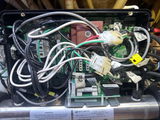
Spa Control Pack In our example, the electrician
installed
flex conduit for the power wires inside the hot tub's equipment bay, referring to the owner's manual hookup
instructions.
Replacement
Spa Packs |

-
Don't forget to read your spa manufacturer's owner
manual prior to installing.
-
Don't forget to get an electrical permit.
-
Don't install a hot tub under overhead power lines.
-
Don't run buried wiring under the spa.
-
Don't connect a 4-wire hot tub to a 3-wire circuit--
it would be unsafe & illegal.
-
Don't use undersized wire.
-
Don't use aluminum wire.
-
Don't install outdoor lighting within 10 feet of hot
tubs.
-
Don't use your hot tub until the
electrical installation has been approved.
-
Don't forget to check the GFCI device frequently,
using its TEST button.
-
Don't forget to maintain water balance and
sanitizer.
-
Don't forget to replace & lock your spa cover after
each use.
-
Don't forget to enjoy your hot tub regularly!
Hot
Tub Safety
Water
Chemistry
Routine Maintenance
Spa
Selector
Spas Requiring Dual 240V GFCI Subpanel Breakers

Subpanel Example |
Some hot tubs, such as certain models of Hot Spring and
Caldera spas (Watkins Manufacturing), require a special subpanel disconnect containing two
separate GFCI breakers: one for the heater, and a second for the
pump and other components. These spas should not be wired to a
single spa circuit breaker box such as our Connecticut Electric
unit. Consult your owner's manual, the dealer, or the manufacturer
for installation information. |
About 120V Portable Hot Tubs

Indoor Outlet |
This guide is aimed at 240 volt portable spa installations, so if you
have a 120 volt plug-n-play spa or are planning on getting one,
most of this information will not apply to you. However, a few spas
are easily convertible to run on either voltage, such as the
popular
Belize
Oval II and
Trinity
Spa models. |

Outdoor GFCI Outlet |
When configured for 120V use, spas in this class are equipped with
a GFCI on the end of the power cord, which plugs into a standard
dedicated household outlet. (Covered GFCI-protected outlets must be used outdoors).
Advantages in converting these hot tubs over to hard-wired 240V
include:
faster heating time and ability to maintain set temperature in very cold
weather. |
|
Legal Disclaimer:
The Spa Depot assumes no liability for the use nor makes
any warranty as to the accuracy, suitability or usefulness of
the information provided herein, which is not intended to
replace or substitute for information contained in the equipment owner's manuals. YOU EXPRESSLY AGREE TO
HOLD THE SPA DEPOT AND ITS EMPLOYEES HARMLESS FOR ANY PROPERTY
DAMAGE, PERSONAL INJURY AND/OR DEATH, OR ANY OTHER LOSS OR DAMAGE
THAT MAY RESULT FROM YOUR USE OF THE INFORMATION PROVIDED. No
advice or information, whether oral or written, obtained by you
from this web site or our employees
shall create any warranty not expressly made herein. Reader
agrees to assume all risk resulting from the application of any of
the information provided herein. By using this web site,
including any applets, software and content contained therein, the
visitor agrees that the use of this web site and its information
product is entirely at his/her own risk.
Read
Caution Statement |
 |
Consumer Reviews |
|
|
Connecticut
Electric GFCI Load Center
"I was very impressed with the quality.
And I really like the fact that we were able to add the outdoor
GFCI electrical outlet (which is required by code where we live)
without having to pay the electrician for wiring a whole separate circuit. That alone more than paid for it!"
Brock Hirsch Bricktown, NJ
|
|
|
|