Acid
Chemicals such as sodium bisulfate, also called Dry Acid, Muriatic
Acid or
pH
Decrease (Spa Down) used to lower pH or alkalinity.
Back to Top
Acid Demand
As determined by a test, the proper amount of acid ( pH
Decreaser) to
reach correct levels.
Back to Top
Acrylic
A very durable and non-porous heat-formable synthetic used to form
the shell of high quality spas.
Back to Top
Air Buttons
Topside spa controls used to activate jets and other spa features.
Back to Top
Air Lock
A condition which inhibits water circulation, and occurs when air
pockets form around the pump or in plumbing, often associated with
draining and refilling. Can usually be corrected by slight loosening
of the pump fittings and allowing the trapped air to escape.
Back to Top
Air Switches
Electro-mechanical devices used to control motors and other devices in the spa.
Back to Top
Algae
Microscopic aquatic plant life which can grow on spa surfaces or float in the water.
Although fairly harmless to bathers, algae discolors the water and
indicates improper sanitization.
Back to Top
Algae Spores
Dormant form of airborne algae which is introduced into spa or pool
water by wind and rain showers.
Algaecide
A chemical used to kill algae and prevent the re-growth.
Spa
Algaecide
Back to Top
Alkalinity
See Total
Alkalinity
Back to Top
Bacteria
Microscopic organisms continuously entering the water via bathers, airborne dust, etc.
Without proper sanitization hot tubs and spas are the ideal breeding ground for
bacteria, many of which can cause disease or infection. See Pseudomonas.
Back to Top
Balanced Water
Water that is neither corrosive nor scale forming. Water with the proper relationships
of pH, total alkalinity and calcium
hardness is said to be balanced.
Back to Top
Base
A chemical which raises pH and/or alkalinity when added to the water such as
pH
Increase, pH Buffer/Alkalinity Increaser, or
Easy
pH.
Back to Top
Bather Load
The number of individuals using a pool or spa in a 24 hour period. This
load is the primary
source of bacterial and organic contamination.
The depth, surface area, and total volume of water are factors as
well as the capacity of water purification apparatus such as
filters, together with water treatment chemicals and
sanitizers.
Back to Top
Biofilm
Biofilm is a complex association of microorganisms which adhere to a hot tub surfaces,
particularly inside the plumbing, where they are difficult to remove. Biofilm may
contain bacteria, viruses, mold, parasites as well as dirt and
polysaccharides which add adhesion to a surface. It grows in the nicks and crannies
within the plumbing systems and jets, forming a slippery film. Microorganisms inside
the biofilm layer are somewhat protected from sanitizing agents such as chlorine,
bromine, or algaecides. These
microorganisms present a danger because if released into the water, a bather may be
contaminated before sanitizers can kill them. It is important
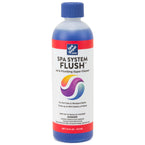
to remove biofilm and prevent it from reforming. We recommend the regular use of
Spa
System Flush to aid in the removal of films and deposits which form
inside the plumbing and jets of your spa.
Back to Top
Break Point
Chlorination
The process of shocking the water with significant quantities of chlorine
to oxidize all contaminants and organic wastes and leave all remaining chlorine as
free chlorine.
Back to Top
Broadcast
A method of dosing powdered chemicals into water by spreading them widely over the
surface. Most spa chemicals, however, should be dissolved
individually in water first, then added to the hot tub water
(never mixed together).
Back to Top
Bromamines
A molecule of combined bromine and ammonia, which unlike
combined
chorine compounds, continues to have sanitizing ability.
Back to Top
Brominator
A floating device, such as
Floating
Bromine-Chlorine Feeder , which holds bromine
tablets and dispenses a metered amount of bromine sanitizer
into the spa water.
Back to Top
Bromine
The preferred sanitizing agent for hot tub spas that kills bacteria
and algae. The tablet form of this product is dispensed using a
floating brominator like the
Floating
Bromine-Chlorine Feeder. The granular form is added upon spa startup
(initial filling) to establish an immediate bromine reserve.
Back to Top
BTU (British
Thermal Unit)
A scale for measuring the capacity of a heating device, such as a gas spa
heater. Technically, the quantity of heat required to raise the temperature of one
pound of water from 60° to 61°F, at a constant pressure of one atmosphere, is one
BTU.
Back to Top
Buffer
A chemical that resists pH change in spa water, such as sodium
bicarbonate or
pH
Buffer/Alkalinity Increase (Spa Up).
Back to Top
Calcium Carbonate
A compound which forms in unbalanced water to form scale.
Back to Top
Calcium Chloride
A soluble white compound used to raise the calcium
hardness of spa & pool water, to protect equipment.
Hardness
Increaser
Back to Top
Calcium
Hardness
A measure of the amount of calcium dissolved in water. Water with low hardness can
lead to corrosion of metal parts. Test strips are available for
checking hardness levels -
Hardness
Test Strips.
Back to Top
Calcium
Hypochlorite (Cal Hypo)
A granular form of chlorine which is commonly used in pools,
but not recommended for spas because it may leave unsightly calcium deposits at the
waterline and scale buildup in heaters.
Back to Top
Carbonates
Compounds which are primary in the makeup of
Total Alkalinity and
TDS.
Back to Top
Cartridge Filter
The type of filter commonly used in spas consisting of a cylinder of pleated fabric
media with end caps.
Filter
Replacement Guide
Back to Top
Cavitation
A vacuum created when the discharge capacity of a pump exceeds the
replacement in the suction line. It occurs when the pump is
oversized, when the diameter of the influent line is too small, or
when there is an excessively long influent line. Cavitation causes
bubbling and vibrations that can damage the pump over time, and it
also reduces pumping efficiency.
Back to Top
Chelating Agent
Stain & scale preventing compounds that sequester dissolved
metals to prevent water discoloration.
Metal
Free
Stain, Scale, Metal Control
Back to Top
Chine
The portion of the stave of a wooden hot tub below the bottom of the croze.
Back to Top
Chitin
A naturally occurring polymer (pronounced KY-tin) found in crab and lobster shells. As
a spa clarifier, it is the best flocculating
agent available. Removes oils, dirt, scum, and metal deposits and
allows the filtering system to work more effectively.
Sea
Klear Natural Clarifier (#CA1013).
Back to Top
Chloramines
Chlorine ammonia compounds (combined
chlorine) formed when chlorine reacts with
organic contaminates in the water. Chloramines are not effective as sanitizers
and are responsible for eye and skin irritation as well as strong chlorine odors.
Back to Top
Chlorine
A sanitizing agent that kills bacteria and algae.
When Chlorine is used in spas, the proper type is Sodium
Dichlor, like our
Granular
DiChlor.
Back to Top
Circuit Board
The electronic brains of a spa, containing relays, contactors, and connecting to all
other electrical components.
Back to Top
Clarifier
A compound used to remove dissolved solids, metals, dirt, oils, or other contaminants
from spa and pool water. Products like
Sea
Klear Natural Clarifier,
containing Chitin
do this naturally
Back to Top
Combined Chlorine
The portion of the total chlorine in water in chemical
combination with ammonia, organics, and nitrogen, most of which
are chloramines.
Back to Top
Contactor
A relay-type device in a spa's electrical circuit which controls power to another
device.
Back to Top
Corrosion
The etching away of metal fixtures and pump seals due to improperly balanced water.
Back to Top
Cover Protectant
A special formulation for vinyl spa covers which prevents deterioration caused by
sunlight and weather such as
303
Protectant.
Back to Top
Cover Removal
Device
A device to aid in the removal, storage and reinstallation of insulated spa covers.
Cover
Lifter Guide
Back to Top
Croze
The milled grooves in the stave of a wooden hot tub which
accommodate the floor planks.
Back to Top
Cyanuric Acid
Also known as Stabilizer, Isocyanuric Acid, Triazinetrione, or conditioner. A compound
that reduces the loss of chlorine in water due to the UV sunlight.
Back to Top
Defoamer
A compound used to reduce or eliminate foaming in spa water.
Foam
Free - Super Defoamer
Back to Top
Dichlor
See Sodium Dichlor
Back to Top
Disinfect
To kill and inhibit growth of harmful microorganisms spa water through the use of a sanitizer
such as bromine.
Back to Top
Diverter Valve
A control valve used to adjust the output of water from
jets in
various sections of the spa.
Back to Top
Draft Hood
Part of an indoor gas heater which vents exhaust to the outside to
prevent a down draft.
Back to Top
Dry Acid
A granular chemical, sodium bisulfate like
pH
Decrease (Spa Down) used to lower the pH and/or total alkalinity.
Back to Top
Efficacy
The power to produce a desired effect, such as the effectiveness of
a sanitizer in spa water.
Back to Top
Effluent
The water that flows out from a pump or filter.
Back to Top
Enzymes
Biodegradable proteins which break-down oils, films and digest scum in spa water
Scum
Buster.
Back to Top
Equilibrate
To bring to a chemical balance or
equilibrium. When adding chemicals to spa water it is advisable to allow a few hours
for them to equilibrate with water circulating, prior to testing, in order to obtain
accurate readings.
Back to Top
Filter Media
A pleated, porous synthetic fabric in filter cartridges, used to trap foreign matter.
Filter cartridges must be cleaned regularly with filter cleaning compounds like
Power
Soak Filter Cleaner and
Eco-Soak
Filter Cleaner to maintain spa water quality.
Back to Top
Flocculent
A compound which clarifies or flocs spa water by gathering small
contaminant particles into larger globules, which then can be easily trapped in the
filtering system. for example, Sea
Klear Natural Clarifier.
Back to Top
Flow Switch
See pressure switch
Back to Top
Free
Chlorine
The amount of chlorine available to kill bacteria
or algae. Also known as Available Chlorine.
Back to Top
Ground
Fault Circuit Interrupter (GFCI)
A fast acting electrical device designed to cut off electricity before it can harm
anyone in its path. Required on spas.
Back to Top
Grounding
Providing or connecting an electric-conducting path to earth.
Equipment is grounded for safety, so that in the event of an
electrical short to ground, the circuit breaker will trip.
Back to Top
Gunite
A mixture of cement and sand, sprayed with machinery onto a contoured and reinforced
surface to form a pool or spa.
Back to Top
Halogen
A family of elements which include bromine and
chlorine.
Back to Top
Hard Water
See Calcium Hardness
Back to Top
Head
The pressure or resistance in a hydraulic system.
Back to Top
Heater Element
The portion of an electric heater unit through which electricity flows to produce
resistance heat.
Back to Top
Heater Manifold
A housing for the heater element through which water
flows.
Back to Top
Heat Exchanger
In spas or pools, a device with plates or coiled tubes which
transfers heat to water.
Back to Top
Hertz (Hz)
The measure of the frequency of alternating current expressed in
cycles per second. AC current in the U.S. is 60 Hz. In Europe and
other parts of the world, 50 Hz is common. 60 Hz. and 50 Hz.
electrical devices are not generally compatible or interchangeable.
Back to Top
High Limit Switch
A safely switch in a heater assembly which shuts-off power to the heater element if
the temperature becomes too great.
Back to Top
Hoops
The circumferential bands of a wooden hot tub which prevent the staves
from separating.
Back to Top
Hot Tub Folliculitis
A skin condition often seen where spa sanitation is at fault. See Pseudomonas.
Back to Top
Hydrogen Peroxide
A compound of hydrogen and oxygen sometimes used as an oxidizer.
In concentrated form is normally too dangerous for consumer use.
Back to Top
Hydrotherapy
Jets
Jet fittings in a spa which blend air with water to create a high-velocity, turbulent
stream which is stimulating to the skin and body.
Back to Top
Hypobromous Acid
The strongest disinfecting form of bromine in water.
Back to Top
Hypochlorous Acid
The strongest disinfecting form of chlorine in water.
Back to Top
Impeller
Part of a pump which rotates to provide centrifugal force for
propelling the water in a recirculation system such as a hot tub or
pool.
Back to Top
Incoloy
A special heat and corrosion-resistant metal alloy used for
making heater element sheaths.
Back to Top
Influent
Water entering a pump or filter.
Back to Top
Ion
An atom or group of atoms carrying an electric charge as a result of having lost or
gained one or more electrons. Also a charged subatomic particle (as a free
electron).
Nature2
works by releasing silver ions, in very small amounts, into the spa water.
Back to Top
Jets
See Hydrotherapy Jets
Back to Top
Kilowatt
A unit of power equal to 1000 watts.
Back to Top
Kilowatt Hour
A unit of work energy which equals the energy expended by 1 kilowatt
in 1 hour.
Back to Top
Langelier Index
A saturation index used to determine relative water
balance by
assigning certain values to various levels of total alkalinity, pH,
hardness and water temperature.
Back to Top
Make-Up Water
Fresh source water used to fill or top-off a spa or pool.
Back to Top
Monopersulfate
Compound (MPS)
See Potassium Monopersulfate
Back to Top
Muriatic
Acid
A form of diluted hydrochloric acid used for reducing pH, and also for dissolving
scale from filter cartridges (called Acid Washing). We recommend a safer
alternative:
Acid
Magic Muriatic Acid Replacement since it will not burn skin, and produces less
fumes.
Back to Top
Nature2
An alternative proprietary spa sanitizing system which does not require the addition
of bromine or chlorine. With this
product, water must merely be dosed regularly with non-chlorine shock
Oxy-Spa
Non-chlorine MPS Shock. Lasts 4 months.
Back to Top
Non Chlorine Shock
An oxygen-based shocking compound, potassium peroxymonosulfate,
Oxy-Spa
Non-chlorine MPS Shock is fast dissolving so it allows hot tub use just
15 minutes after application (see Shock).
Back to Top
Organic
Contaminants
Wastes such as body oils, perspiration and sun tan residues which bathers introduce
into the spa. Most organic wastes will not filter out and must be broken-down by
shocking with an oxidizer such as
Oxy-Spa
Non-chlorine MPS Shock.
Back to Top
ORP
The oxidation reduction potential or redox produced by strong oxidizers in water.
Primarily of concern in pools.
Back to Top
OTO
A test reagent used to test bromine and chlorine
in pool and spa water in liquid test kits.
Back to Top
Overflow System
See SKIMMER
Back to Top
Oxidizing
The process of breaking down organic wastes by the addition of a shocking compound
like
Oxy-Spa
Non-chlorine MPS Shock to the spa water.
Back to Top
OxySpa
See SHOCK.
Oxy-Spa
Non-chlorine MPS Shock
Back to Top
Ozone
The triatomic (three atom) very reactive form of oxygen that is formed naturally in
the atmosphere by a photochemical reaction. In spas, it is produced by an Ozonator,
used for oxidizing contaminants and helping with the disinfecting process.
Back to Top
Ozonator
An electrically-powered device which produces Ozone. Ozone
is a helper disinfectant, but due to its very short half-life in hot water, cannot do
the job of sanitizing spa water all by itself.
Back to Top
Peroxide
See Hydrogen Peroxide
Back to Top
Peroxymonosulfate
See Potassium Monopersulfate.
Back to Top
pH
A scale of the relative acidity/alkalinity of water. The pH scale runs from 0 to 14,
with 7 being the neutral midpoint. A pH reading of less than 7 indicates water which
is on the acid side of the scale. A pH of more than 7 is on the
basic (alkaline) side. In spas, the acceptable range is
between 7.2 and 7.8.
Back to Top
pH Buffer
See Sodium Bicarbonate
Back to Top
pH Decrease
An acidic chemical used to lower pH or alkalinity.
pH
Decrease (Spa Down)
Back to Top
pH Increaser
A base compound, sodium carbonate or soda
ash, used to raise pH & Total Alkalinity like
pH
Buffer/Alkalinity Increase (Spa Up). Not to be confused with sodium
bicarbonate.
Back to Top
Phenol Red
Chemical reagent used for testing pH in the range of 6.8 - 8.4. Found in liquid test
kits.
Back to Top
Potassium Carbonate
Sometimes sold in liquid form as pH increaser. It is generally more expensive than the
powdered pH or alkalinity increasers, but not significantly more effective.
Back to Top
Potassium
Monopersulfate
An oxygen-based shocking compound, such as
Oxy-Spa
Non-chlorine MPS Shock. This non-chlorine shock is fast dissolving so
it allows hot tub use just 15 minutes after application (see Shock).
Also called Potassium Peroxymonosulfate. Oxy Shock is also essential for the
activation of sodium bromide (bromine tablets). The
bromide ion by itself has no disinfecting capability. The monopersulfate
compound in OxyShock activates the bromide ion to become bromine, which then rapidly
becomes the active sanitizer: hypobromous
acid, in spa water. Upon reaction with bacteria and
other contaminants, hypobromous acid is reduced back to bromide ion, ready to be
reactivated again by the next dosage of Oxy Shock.
Back to Top
PPM
Parts per million. (Example: 5 cents in $10,000 = 5 PPM).
Back to Top
Precipitate
A solid which is forced out of solution in water to form flakes or haze (turbidity)
in suspension.
Back to Top
Pressure Switch
A safety switch which shuts-off power to the heater element if water flow is not
detected.
Back to Top
Pseudomonas
Pseudomonas bacteria can cause Hot Tub Folliculitis,
a condition often seen where spa sanitation is at fault. The most common symptom is an
itchy rash or small reddish bumps, sometimes confused with bug bites. Read more
about symptoms, causes, and prevention:
Spa
Microbiology 101.
Back to Top
Quaternary Ammonium
Organic compounds of ammonia (Quats or QAC) sometimes used as an
algaecide.
Back to Top
Relay
A device in a spa's electrical circuit which controls power to another device.
Back to Top
Return Inlet
The fitting through which water returns into a spa from the circulating pump.
Back to Top
Roto-Molding
The rotational molding process begins with a
quality mold placed inside a machine that has a heating and
cooling area. Plastic resin beads are poured into each mold. The
molds are next conveyed into an oven where they are slowly rotated
on horizontal and vertical axis simultaneously. The melting resin
sticks to interior sides of the heated mold and coats all surfaces
very evenly. It rotates continuously during a cooling cycle so that
the finished product retains an even wall thickness for strength.
Dream Maker
Spas spas are roto-molded unibody construction.
Back to Top
R-Value
The measure of resistance to the flow of heat through a given thickness of a material
(as insulation) with higher numbers indicating better insulating
properties. In spa covers, a higher R-Value will save energy costs.
Back to Top
Safety Cover
A spa cover which meets ASTM standards for
strength, construction, and anchoring.
Back to Top
Sanitizer
A compound such as bromine or chlorine,
or a metal ion formulation based on copper or silver,
used to kill microorganisms in spa water.
Back to Top
Scale
Calcium crust or buildup caused by unbalanced water. These mineral deposits forms on
spa surfaces and clog filters, heaters and pumps. The regular use of stain prevention
chemicals can prevent scale formation.
Back to Top
Scale & Stain
Preventer
A product which prevents the formation of calcium scale and metal stains on spa
fittings caused from copper and iron plumbing. For example
Metal
Free
Stain, Scale, Metal Control.
Back to Top
Sequestering Agent
See CHELATING AGENTS
Back to Top
Scum Digester
An enzyme product which breaks down body oils, soap film and
lotion residues in spa water, like
Scum
Buster.
Back to Top
Shock
Addition of an oxidizer such as
Oxy-Spa
Non-chlorine MPS Shock or superchlorinator to
break-down the organic contaminates on which bacteria feed.
Also called Oxyshock.
Back to Top
Skimmer
The skimmer is a basket, usually located above the filter.
Its purpose is to collect large debris and prevent it from
reaching the filter. Use of
Skimmer
Sock Pre-Filters over the skimmer will further decrease the amount of
debris which would otherwise reach the filter, and make filter cleaning easier.
Back to Top
Soda Ash
Common term for sodium carbonate such as
pH
Increase - pH & TA Increaser which is used to raise pH and Total
Alkalinity of spa water. Sodium carbonate or soda ash has a pH of 13.
Back to Top
Sodium Bicarbonate
Commonly used to increase the Total Alkalinity (TA) of spa water for example
pH
Buffer/Alkalinity Increase. The uncommon chemical name is Sodium Hydrogen
Carbonate (not to be confused with Sodium Carbonate.) If the water's pH is below
the normal range, raising the TA with this chemical will often buffer the pH or bring
it into proper range. Sodium bicarbonate has a pH of 8.3.
Back to Top
Sodium Bisulfate
Also known as dry acid, the chemical used to lower pH and
total alkalinity of spa water (pH Decrease).
Back to Top
Sodium Carbonate
See Soda Ash.
pH
Increase - pH & TA Increaser
Back to Top
Sodium
Dichlor
The type of chlorine which is most effective for use in
spas. Sometimes used as a sanitizer, and is a very good
shock for problem spas, particularly when cloudiness due to high bather load is a
factor. Chemical names: sodium dichloro-isocyanurate and
sodium dichloro-s-triazinetrione. Also called Dichlor.
Granular
DiChlor.
Back to Top
Sodium Hypochlorite
The form of chlorine in liquid household bleach. Not
recommended for spas because it has limited effectiveness in hot water, adversely
affects pH balance, and can damage spa surfaces if spilled or
splashed.
Back to Top
Soft Water
Water with very low levels of dissolved calcium. Can be corrected with calcium
hardness increaser like
Hardness
Increaser.
Back to Top
Spa Fragrance
Special perfumes designed to enhance the hot tub experience and overcome chemical
odors. These are designed for spas, and will not alter water balance or clog filters
Spa
Fragrance Department.
Back to Top
Spa Pack
An integrated unit consisting of electronic or mechanical controls, which may include
a water pump, GFCI and other devices.
Spa
Pack Department
Back to Top
Stabilizer
See CYANURIC ACID
Back to Top
Staves
The vertical boards of a wooden hot tub.
Back to Top
Suction Outlet
The fitting, often near the skimmer, through which the water is
drawn from the spa.
Back to Top
Superchlorination
Application of large shock dosages of chlorine
to destroy buildup of organic contaminates in water. An alternative is to use a
non-chlorine shock like
Oxy-Spa
Non-chlorine MPS Shock.
Back to Top
Test Kit
A set of chemical solutions and color references for testing pH, total
alkalinity and sanitizer levels of spa water. We
recommend instead the use of Test Strips which are very accurate
and much easier to use.
Test
strips and kits
Back to Top
Test Strips
Easy-to-use dip strips for measuring the pH, total
alkalinity and sanitizer levels of spa water. Strips are
also available for testing water hardness levels.
Testing
supplies
Back to Top
Thermostat
A device, either electronic or mechanical, which controls the operation of the heater
by sensing water temperature.
Back to Top
Timer
A clock that automatically controls the pump and other devices in a spa.
Back to Top
Topside Controls
A set of button or knob switches, either pneumatic or electronic, for controlling a
spa's pump, jets, heater, and other features.
Back to Top
Total
Alkalinity (TA)
The measure in PPM of all the dissolved base/alkaline material in
the water. The acid-neutralizing capacity of water which indicates its buffering
ability, or resistance to fluctuations in pH.
Back to Top
Total Chlorine
The sum of combined and free chlorine.
Back to Top
Total
Dissolved Solids (TDS)
A measure of the amount of matter which is in solution in spa water. This
includes: calcium, magnesium, carbonates, bicarbonates, metallic
compounds, etc.
Back to Top
Trichlor
Another form of chlorine, often supplied in tablet form, and
used for pools. Not recommended for spas and hot tubs because of its acidic
nature. Prolonged contact with spa shell may bleach or permanently mar the
surface.
Back to Top
Turbidity
A cloudy condition in water due to the presence of suspended particulates or
precipitated material such as scale.
Back to Top
Turnover
The time period required to completely circulate an amount of water
equal to the volume of a vessel, such as a pool or spa.
Ultra Violet (UV)
With regard to spas, Ultra Violet light is a part of the light spectrum that is
particularly damaging to vinyl spa covers. Use of a Cover Protectant, such as
303
Protectant, blocks UV rays to prolong cover life.
Back to Top
Urethane Foam
A spray-in insulating material used in hot tubs. Reduces heat loss
and also provides some structural support for plumbing and cabinet
shell.
Back to Top
Vacuum Ultra
Violet (VUV)
The light frequency in which ozonators operate.
Back to Top
Velocity
Water movement rate, as measured in gallons per minute or feet per
second.
Back to Top
Venturi
A tube with a tapering constriction in the middle that causes an increase in the
velocity of flow of a fluid and a corresponding decrease in fluid pressure. In
spas, Venturi fittings with side drafts are sometimes used to introduce air into jet features,
and to pull ozone from Ozonators into the
spa water.
Back to Top
Volute
A pump housing containing an impeller and a diffuser.
Back to Top
Watt
A derived unit of electrical power. Amps x Volts = Watts.
Back to Top
Weir
A part of a hot tub or pool skimmer that automatically adjusts to
water level.
Back to Top
Winterizing
The procedure of preparing spas for freezing weather, in cold climates when the spa
will not be operated. May include draining and cleaning the shell, and opening
connections to release water from plumbing and heaters. Most people continue to
heat and operate their spas in winter; for them, winterizing is not necessary if
appropriate measures are taken to prevent freeze-up.
Spa
Winterizing info
Back to Top
Working Pressure
A specification of maximum operating pressure, as recommended by an
equipment manufacturer.
Back to Top
X-Spa
A series of rotationally-molded hot tub models manufactured by
DreamMaker
Spas.
Back to Top
Yellow Algae
A variety that clings to pool walls, also known as mustard
algae.
Typically found in shady areas. Very resistant to normal levels of
chlorine.
Back to Top
ZorbO
The brand name of a very effective oil scum absorbing product. Wicks scum
without absorbing spa water.
ZorbO
Scum Absorber
Back to Top
|