Go Ahead! Start our Amazing Spa Simulator
Visualize exactly how a hot tub works.
Our interactive schematic diagram is a visual insight into a hot tub's plumbing,
filtration, circulation systems, and jets, as explained in more
detail below. It's much more than a water
flow diagram! Even if you never
perform service on your own spa, a basic understanding of its
inner-workings will likely make ownership a more carefree
experience in the long run. (Pump location may vary).
Advice: If you are
going to be away from your computer for a period of time, Dr. Tubbs
recommends that you switch off the pump motor and air blower control
buttons above, to conserve electrical power.
Control System
 |
Today's spas have digital topside keypads from which various
hot tub functions, including jet pump or spa pumps, light, and heater can
be controlled and programmed. (Earlier spas used air buttons
for these functions). |
This keypad is connected to the spa's Control
System, a box which regulates the functioning of various devices. The Control System
or spa pack and
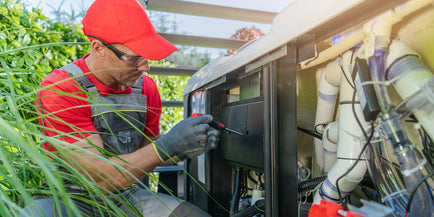
associated components are located in your hot tub's equipment bay.
Most spas have removable access panels attached with screws, as depicted in our Spa Simulator video.
|
Filter Systems: Suction and Pressure Types
All hot tubs have something in common: they recirculate, heat, and
filter water. But various brands do this in slightly different
ways, primarily dependant upon the type of filtration system used.
Your spa will have either a suction filter, which means it is connected
before
the spa pump's intake, or a pressure filter which is connected after
(hence it's pressurized by the pump).
Regardless of the spa filter type, water is basically taken from the
surface, pumped through the heater, and returned to the spa via a
network of plumbing tubes connected to jets. Both system
types can provide excellent water filtration, although systems with
floating Weirs have superior surface skimming.
 |
Suction Filters
The majority of today's spas have suction filter systems, which
are always top mounted for easy cartridge access. |
These come in two basic varieties. Pictured
above is a floating Weir which automatically telescopes to the
spa's surface water level to skim impurities. The Weir
unscrews to expose the filter cartridge inside.
Belize
Spas use telescoping Weirs. |
| The other variety of suction filter incorporates a
skimmer basket, which houses one or more drop-in or screw-in
(threaded) cartridges. |
 |
 |
Pressure Filters
Many spas still use pressure filters. In these systems, the
filter cartridge is housed in a sealed canister, rather than
incorporated with a surface skimmer. The skimmer (water
intake) is a separate unit by itself. |
| The earliest spas had base-mounted pressure filter
canisters, accessible only by opening up the spa's equipment
compartment. Modern versions have top-mounted canisters,
designed for easier filter cartridge changing from the spa-side. |
Pump & Heater
Hot tub water is drawn from the
surface, as well as from one or more suctions in the footwell, to the
spa pump. (Most spas have at least one 2-speed pump; some have more
than one pump).
| Water now flows through a heater housing* where it is
warmed to the desired temperature. This assembly contains a
resistance heater element as shown here. |
 |
The heater system
incorporates a pressure or flow switch, and an overheat high-limit
switch. These are safety devices to cut heater element power,
should water flow be restricted or overheating occur. The water
temperature is controlled at the topside keypad, up to a maximum of
104ºF (the legal limit).
*NOTE: Some
systems are plumbed with the pump located after the heater.
Pump
Replacement Heater
Testing
Jets
 |
The warmed water now flows through large PVC tubing to one or
more water manifolds, where it is distributed via many smaller
tubes to the jets. Better spas have fully adjustable,
directional air-induction jets of various sizes, with different
attributes. |
Air Induction
 |
Today's spas incorporate air-inductions jets,
which mix warm water with air in the user's desired proportions
using a topside control. |
Better
manufacturers, including
Belize
Spas, draw free waste heat from air in the equipment
compartment (from the pump motor) to improve
heating efficiency. High quality air-induction jets preclude the
necessity for a separate powered air blower, further saving energy.
| Air-induction jets have both a water connection, and an air
Venturi connection. The rate of air flow to the jets is
regulated by a topside air control valve (or it can be shut off
altogether if desired). Like the water, air is also distributed
to the various jets via a manifold, as shown in our Spa Simulator
video. |
 |
Ozonator
An spa ozonator (ozone generator) is connected by small diameter tubing
to either an injector Venturi or to a special ozone jet, which is low
in the spa water for maximum water contact, and which draws the ozone
in by suction. Notice that the ozone tube loops above the hot
tub's water line. This is called a Hartford Loop, which along
with a check valve helps to prevent water from backing into the
ozonator.
Modern electronic UV ozonators are extremely reliable and effective. Operated
by the control system, ozonators are only on during operation of a
hot tub pump circuit.
Adding an ozonator is not a necessity, but can help reduce chemical
usage and significantly improve water quality. Ozone is not a primary
sanitizer, and cannot be used all by itself to keep hot tubs safe and
healthy (contrary to what some ill-informed salespeople may tell you).
It works with your sanitizer for better water quality by oxidizing
contaminants and organic material.
Light
Most spa lights operate on 12 volts, and are controlled at the
topside keypad. The bulbs can easily be changed if the socket is
located behind the equipment access door.
 |
The hot tub's standard incandescent light bulb can be swapped
out for a multiple-LED digital color lighting unit at very modest
cost.
Digital
Color Spa Light |
Drain
| Most spas have a drain bib (a plastic faucet)
inside the removable access panel. Some spas have no drain and
must be siphoned. Better hot tub brands feature an external drain
fitting, so that they can quickly be emptied by attaching a garden
hose. |
 |
Air Blower
An electric air blower is essentially a vacuum cleaner in reverse.
They force air via a manifold through many tiny orifices drilled in a spa shell or
through small air-injector fittings, rather than mixing air with water
via air-induction jets.
 |
Blowers
should be installed with their delivery hose in a Hartford Loop above
the waterline, as well as with a blower check valve on the wet side,
to prevent water from backing into the unit and causing an
electrical short. |
Although popular years ago, most contemporary spa manufacturers have abandoned
powered air
blowers. The advent of high efficiency air-induction jets
has made them unnecessary. Blowers also rapidly cool down the
spa, especially in winter, which wastes the energy necessary to reheat the water.
Power Service
Full-sized acrylic spas operate on a hard-wired, GFCI-protected
220-240V service. The wiring enters the equipment compartment
through a hole drilled through the spa side or toe kick, as shown in
our Spa Simulator. (110V Plug-n-Play spas usually have a
GFCI device attached to the end of their power cord, and are plugged
into a dedicated outlet).
| IMPORTANT: Consult your
owner's manual for electrical hookup requirements. Working
around electricity and water is dangerous. All electrical work
must be performed by a qualified electrician in accordance with
the National Electrical Code and in compliance with local codes.
Consult your local building/electrical department for details,
permits, and required inspections. |
|